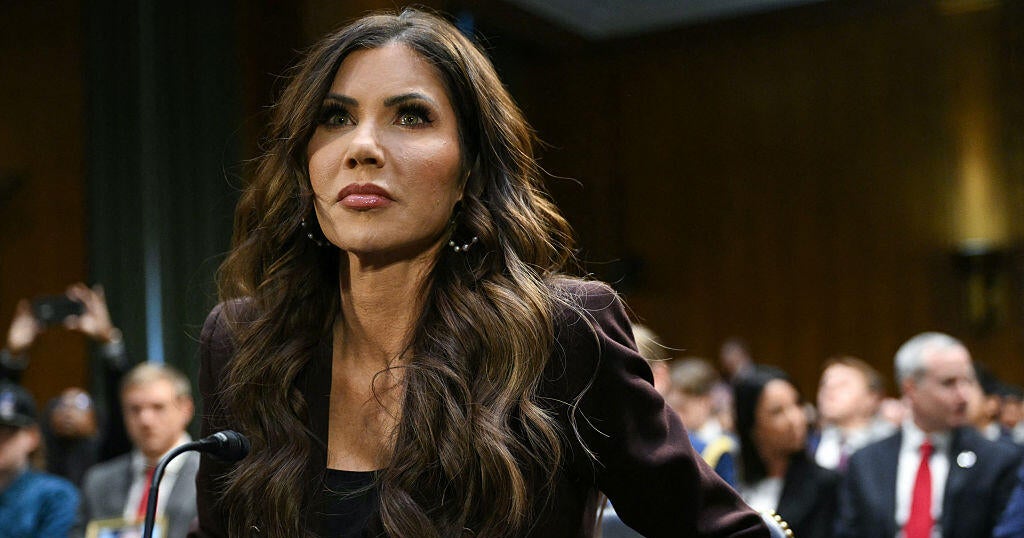
Homeland Security Secretary Noem Blames Chaos for Minneapolis Protestor Portrayals Amidst Senate Scrutiny
Homeland Security Secretary Kristi Noem recently found herself at the heart of a heated congressional hearing, facing intense questioning regarding her department's immigration enforcement tactics and, most notably, her initial characterization of two protestors killed by federal officers in Minneapolis. Her defense hinges on a claim of a "chaotic situation," an explanation that has drawn both understanding and skepticism from lawmakers and the public alike.
The controversy stems from a federal operation in Minneapolis, initially framed as an effort to combat fraud, which saw hundreds of Immigration and Customs Enforcement (ICE) and Customs and Border Protection (CBP) officers deployed to the state. This deployment was met with significant public opposition, culminating in protests where two U.S. citizens, Renee Good and Alex Pretti, tragically lost their lives during encounters with federal agents. In the immediate aftermath, Secretary Noem and other administration officials portrayed these individuals as "agitators," a narrative that local officials and bystander video evidence quickly challenged.
During her appearance before the Senate Judiciary Committee, which stretched nearly five hours, Secretary Noem offered a different framing, attributing her initial problematic characterizations to the prevailing disorder. Her testimony focused heavily on defending her department's actions and pushing back against what she described as "deliberate mischaracterizations" of law enforcement's work.
The Minneapolis Tragedy: A Catalyst for Congressional Scrutiny
The tragic deaths of Renee Good and Alex Pretti in Minneapolis earlier this year became a flashpoint, galvanizing widespread opposition to the Trump administration's aggressive mass deportation agenda. While the administration maintained that its officers were responding to a hostile environment, accounts from local officials and compelling bystander videos painted a different picture, raising serious questions about the federal response and the circumstances leading to the deaths.
Secretary Noem's initial comments, which seemed to dismiss the victims as mere "agitators" or even imply they were engaged in "domestic terrorism," sparked outrage and intensified calls for accountability. Many critics viewed these statements as a dangerous attempt to dehumanize citizens exercising their right to protest, further inflaming an already tense situation. This incident underlined the profound disconnect between federal narratives and on-the-ground realities, placing immense pressure on Noem during her first congressional appearance since the shootings.
For more detailed insights into the Senate's questioning, read our related article: Senate Grills Noem on ICE Tactics & Protestor Controversy.
Noem's Defense: "Chaotic Situation" and Blaming Rhetoric
When pressed by senators, particularly by Senator Peter Welch (D-Vermont), who asked if she would apologize to the families of Good and Pretti for characterizing them as engaging in domestic terrorism, Secretary Noem responded by emphasizing the chaos of those days. "I certainly offer my condolences to these families for their loss," Noem stated. "It’s a tragic situation that we saw in Minneapolis. We continue to work to..." she added, suggesting an ongoing effort.
Her core defense for her initial statements was that she was "working with information she received from field agents" in what was undeniably a fluid and unpredictable environment. This explanation, while offering a condolence, subtly suggests that any mischaracterization was a consequence of the fog of war, rather than a misjudgment of her own. In essence, while offering an explanation, some observers might interpret this as a form of noem refuse excuses rather than a full admission of fault for the initial public statements. She did not explicitly retract her earlier descriptions but rather contextualized them within the operational difficulties.
Beyond the Minneapolis incident, Noem used her platform to defend her department's broader immigration enforcement activities, describing a "dangerous environment" faced by ICE officers. "They are facing a serious and escalating threat as a result of deliberate mischaracterizations of their heroic work and rhetoric that demonizes our law enforcement," she asserted. This framing attempts to shift blame to activists and critics for creating an adversarial atmosphere, rather than acknowledging potential issues within the enforcement tactics themselves. Retiring Republican Sen. Thom Tillis of North Carolina even called her leadership a "disaster," skewering her handling of the immigration crackdown and emergency response.
Analyzing the "Chaos" Defense and Its Implications
While the notion of a "chaotic situation" can certainly complicate real-time information gathering, a leader's response to such chaos is often seen as a litmus test of their leadership. Critics argue that blaming chaos, while understandable to a degree, does not fully absolve a high-ranking official from the responsibility of verifying information before making public statements that can have significant implications, especially when those statements disparage deceased citizens. The impact of labeling individuals as "agitators" or even implying "domestic terrorism" is profound; it can erode public trust, justify aggressive tactics, and even suppress legitimate dissent.
The phrase "noem refuse excuses" captures the sentiment among those who felt her response, while acknowledging tragedy and offering condolences, still fell short of taking full accountability for the divisive rhetoric initially employed. In a crisis, effective leadership demands not just action, but also clear, accurate, and empathetic communication, especially when human lives are at stake. The incident underscores the critical need for public officials to exercise extreme caution and verify facts before making pronouncements that can shape public perception and policy.
Broader Enforcement Tactics and Ongoing Congressional Battles
The Minneapolis controversy is inextricably linked to the broader, often contentious, immigration tactics pursued by Noem's department. The administration's mass deportation agenda, a cornerstone of President Trump's second term, has been aggressively implemented, leading to a significant increase in federal enforcement across the country. This includes purchasing warehouses for immigration detention and maintaining a presence, like the 650 investigators still in Minnesota for a fraud probe, long after initial operations conclude.
These tactics have not only triggered public protests but also a fierce clash in Congress over the department's routine funding. Noem herself did not shy away from engaging in this political battle, calling a partial government shutdown "reckless" and blaming Democrats for actions she claimed jeopardized national security. This highlights the deep partisan divide over immigration policy, where the enforcement efforts defended by Noem are consistently under scrutiny.
For a deeper dive into Secretary Noem's defense of her department's operations, explore our related article: Kristi Noem Defends Immigration Crackdown Amid Criticism.
Lessons in Crisis Communication and Public Accountability
The Noem testimony offers crucial lessons for public officials navigating high-stakes situations:
- Verify, Verify, Verify: In a "chaotic situation," the premium on verifying information before public statements is exponentially higher. Relying solely on initial field reports without independent corroboration can lead to damaging inaccuracies.
- Empathy First: When lives are lost, regardless of the circumstances, an immediate message of empathy and condolence should precede any attempts at justification or blame.
- Accountability in Leadership: While front-line agents face immediate dangers, leaders bear ultimate responsibility for the narratives and policies emanating from their departments. Acknowledging mistakes or misjudgments can build trust more effectively than perceived deflections.
- Long-Term Impact of Rhetoric: Labeling citizens, especially those who have died, with terms like "agitator" or "terrorist" has long-lasting consequences, influencing public discourse and potentially escalating tensions.
The public, and indeed Congress, expects transparency and a clear chain of accountability, especially when government actions lead to civilian deaths. When officials are perceived to noem refuse excuses for past missteps, the path to regaining public confidence becomes significantly steeper.
Looking Ahead: The Ongoing Debate Over Immigration Enforcement
The hearing underscored the ongoing and deeply entrenched debate over immigration enforcement in the United States. While Secretary Noem staunchly defended her department's "heroic work" and blamed external rhetoric for endangering officers, critics, including members of Congress, continued to question the proportionality and human impact of these tactics. The administration's unwavering commitment to its mass deportation agenda, coupled with the tragic incidents in Minneapolis, ensures that the scrutiny of Homeland Security's operations, and its leadership's responses, will continue unabated.
The challenges facing Homeland Security, from border security to internal enforcement and the management of civil unrest, are immense. Adding to the complexities, her appearance also followed a weekend shooting in Texas, being investigated as a possible act of terrorism, leading to concerns that escalating conflict in Iran could have repercussions for U.S. security. How leaders like Secretary Noem choose to communicate, take responsibility, and adapt to evolving information will undoubtedly shape not only public perception but also the future direction of national policy.
Conclusion: Secretary Noem’s testimony before the Senate Judiciary Committee provided a candid glimpse into the pressures faced by Homeland Security leadership, particularly concerning the Minneapolis protestor portrayals. While she attributed her initial statements to the "chaotic situation" and offered condolences, her explanation has been met with mixed reactions, with many interpreting it as a case where Noem refuse excuses for what critics view as mischaracterizations. This incident, set against the backdrop of an aggressive mass deportation policy and escalating tensions, highlights the complex interplay between federal enforcement, public protest, and the critical need for transparent, accountable, and empathetic leadership in times of crisis. The debate over her department's tactics and her leadership will undoubtedly continue as immigration policy remains a central, divisive issue.